Folded-paper logic with strict two-turn connection puzzles
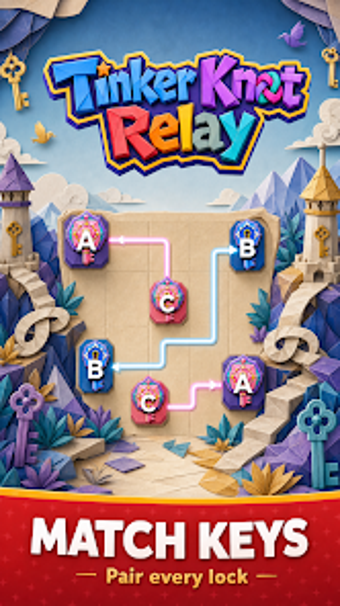
Tinker Knot Relay: Puzzle from Bacon Bit Studios is a compact logic game that asks players to connect matching keys inside a folded-paper world, emphasizing spatial reasoning and order-based problem solving. The core mechanic forces links to follow paths that bend no more than twice, while levels impose move limits, hint tokens, and tape blockers as obstacles. The app's colorful paper aesthetic and short, focused boards suit casual gamers and puzzle fans seeking quick brain-training sessions during short play windows.
What kind of puzzle demands careful sequencing and short sessions?
The app frames each board as a tight planning problem that rewards pattern reading and sequence choices. Players study letter keys and select pairs in an order that preserves available routing, so progress depends more on planning than reflexes. This design makes each level feel like a compact logic exercise, appropriate for short, focused play if you want discrete mental tasks rather than long marathon sessions.
Does the two-turn constraint alter how you approach levels?
The restriction on path bends forces prioritization and route foresight, turning what might be a casual connect-the-dots task into a spatial puzzle about order and economy. Support systems include a limited move allowance and a hint-token mechanic that previews routes. These systems combine to create a risk-reward loop: using a hint eases a stuck board, while conserving moves preserves your chance to finish denser stages.
What does the game look and sound like?
The presentation leans into a folded-paper motif that keeps the visual field uncluttered and pleasant. Colors are vivid but restrained, which helps separate matching keys on denser grids. Audio cues are subtle and supportive, reinforcing successes without drawing attention away from puzzle solving. The interface keeps controls direct and tap-based, so the visual and sonic design supports a calm, contemplative solving pace.
Is progression fair and does it invite replay?
Difficulty ramps through denser grids and the introduction of tape blockers that force detours; later stages demand more precise planning. Short, self-contained boards encourage replaying levels to refine strategies, and the hint system prevents dead ends while remaining a limited resource. Players who enjoy iterative problem solving and gradually tougher challenges get the most from the app's pacing and level structure.
In summary, a focused pick for planners who prefer short puzzle bouts
Tinker is a measured choice for casual puzzle players who enjoy concise, order-driven challenges and tidy session lengths. The game rewards careful sequencing and thoughtfulness rather than speed, though players expecting relaxed, open-ended play may find its constraint-driven design less forgiving. In summary, it suits anyone seeking compact spatial puzzles that test planning under resource limits.